

A script breakdown turns the screenplay into lists of what each scene needs on the day: people, props, wardrobe, vehicles, effects. Those lists feed the shooting schedule and the budget. The first assistant director usually does it; on a short film it may fall to the director or the producer.
1. Lock the draft
Before you mark anything, agree on the one draft the whole crew works from. Put the date and revision number on the title page, then number the scenes if they aren't numbered yet.
From here on, scene numbers stay put. A scene added between 12 and 13 gets a letter: A13 in the US convention, 12A in the UK one. A cut scene stays in the list marked "omitted", so its number is never reused. That way the schedule, the breakdown and every department's notes keep talking about the same scenes.
Many productions print revised pages on colored paper and mark changed lines with an asterisk in the margin. The Writers Guild of America recommends an order that starts with white and goes on to blue, pink, yellow and green, though not every production follows it. What matters is the convention you set at the start.
2. Measure each scene in eighths of a page
Scene length is counted in eighths: half a page is 4/8, a page and a quarter is 1 2/8. The count helps you estimate how much work a day can hold.
According to The Filmmaker's Handbook, a low-budget film typically shoots three or four pages in a twelve-hour day. That's an average. A 2/8 action scene can take longer than two pages of dialogue.
3. Read one scene at a time
For each scene, note the heading (interior or exterior, location, day or night), the characters who speak, the ones who are there but silent, and what happens.
Read it twice: once to understand it, once to look for what has to be prepared. Many needs aren't spelled out. "Thomas walks in soaked" means a wet costume, and often a dry duplicate for later takes. If a detail is unclear, flag it as a question for the director instead of guessing.
4. List the elements by department
Fill in one breakdown sheet per scene and sort the elements by department. The usual categories are:
- cast
- background and extras
- stunts
- props
- wardrobe
- hair and makeup
- set dressing
- vehicles
- animals
- weapons
- special effects and VFX
- sound and music on camera
On US productions each category has a highlighter color: red for cast, purple for props, pink for vehicles and animals. Colors vary from one production to the next. The whole crew just needs to use the same key.
Write each element in enough detail for the department to source it. "Brown leather bag, left shoulder" is more useful than "bag".
Worked example
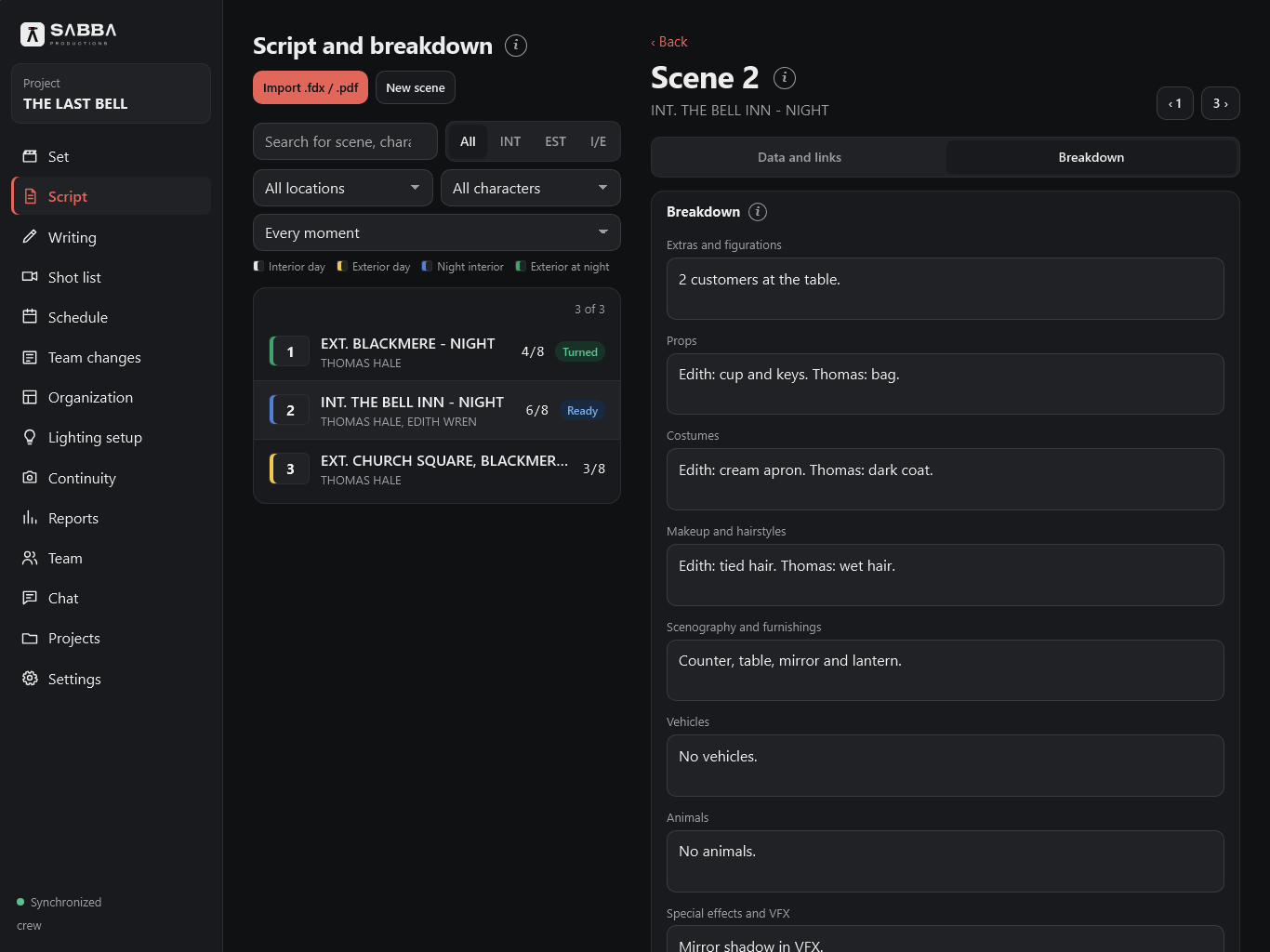
Scene 2, INT. THE BELL INN - NIGHT, 6/8 of a page. Edith is closing the inn for the night; Thomas has just come in from the street, still wet.
| Department | Elements |
|---|---|
| Cast | Thomas Hale, Edith Wren |
| Background | 2 customers seated at a table |
| Props | Edith: bunch of keys and a mug. Thomas: bag on his left shoulder |
| Wardrobe | Edith: cream apron over a burgundy dress. Thomas: dark coat and grey scarf |
| Hair and makeup | Edith: hair tied back, flour on her hands. Thomas: wet hair |
| Set dressing | Wooden bar, table, clouded mirror, lantern |
| Special effects and VFX | Shadow in the mirror, added in post |
Thomas's wet hair and coat carry over from scene 1, shot outside in the rain. The breakdown records them because hair, makeup and wardrobe have to match that state, even if the two scenes shoot on different days.
5. From breakdown to shooting schedule
Once every scene is broken down, group them by location, time of day and cast. You rarely shoot in script order: it's usually cheaper to shoot every scene at one location together, even if they're far apart in the film.
The breakdown also shows when an actor, an animal or a special vehicle is needed in only a few scenes. Putting those scenes on the same days cuts costs and waiting time.
6. Update the breakdown when the script changes
Check every new revision against the breakdown, scene by scene. Review the changed scenes, update the elements and tell the departments involved. A cut scene stays in the breakdown as omitted, with its elements struck, so nobody keeps preparing them.
Common mistakes
- Working from different drafts. If wardrobe has the blue pages and the AD has the pink ones, the lists stop matching.
- Listing elements without scene numbers. "Three bags" isn't enough: the department needs to know which scenes they're in and who carries them.
- Missing implied needs such as rain, blood, or food eaten during the scene. Write them down even when the script barely mentions them.
- Vague descriptions. "Smart dress" means a phone call back to you; color, period and condition don't.
- Skipping the read-through with heads of department. Wardrobe, makeup and art department catch things a first pass misses.
Breaking down a script in 
In SABBA you import the script as a Final Draft file or a PDF and fill in the breakdown on each scene's card, sorted by department. The same data flows into the shooting schedule and the call sheet, with no retyping.