

The call sheet tells the whole crew what shoots tomorrow, where, at what time and with whom. The assistant director usually writes it from the shooting schedule, and production checks it before it goes out. Send it the evening before: anyone who gets it at six in the morning has no time to plan.
1. Start from the shooting schedule
The call sheet reports what the schedule has already decided. Take the scenes planned for the day, in the order you'll shoot them, and check that each one's breakdown matches the latest draft of the script.
2. Write the header
The top of the sheet holds what everyone looks for first:
- project title and shoot day number ("Day 1 of 3")
- date, with the day of the week
- general crew call
- meal break and estimated wrap
- sunrise, sunset and weather forecast
Sunrise and sunset decide when you can shoot dawn and dusk scenes, and the camera department uses them to plan the light.
3. List the scenes
For each scene, give the number, the heading (interior or exterior, location, day or night), the length in eighths of a page, a one-line summary and the characters in it. Add up the day's pages at the bottom: the total tells you at a glance whether the plan is realistic.
If you already know how you'll cover a scene, you can add the planned shots. Camera and lighting can then prepare without waiting for the morning walkthrough.
4. Set the call times
The general crew call is when the crew starts work, not when you roll the first take. Lighting and set preparation happen in between.
Actors get their own times: arrival, makeup, wardrobe and ready on set. Background actors often arrive earlier, because they have to be checked in and dressed. If a department starts before the others, such as art or special effects, give it its own call.
5. Add locations and logistics
For each location, write the full address and a meeting point if the entrance isn't obvious. Then add parking, access for the trucks and an on-site contact.
Always list the nearest hospital or emergency room, with its address. You hope nobody needs it, but when someone does, there's no time to look it up.
6. Add department needs and safety notes
From the breakdown, list what each department needs ready: wardrobe, makeup, props, vehicles, animals, effects. Put the scene number next to each item.
Safety notes go where nobody can miss them: stunts, prop weapons, night or street shooting, work in the rain. People who skim the sheet still have to see them.
7. Finish with contacts
List the numbers for production, the AD team and the location contact. Many crews also add an advance schedule for the next day, which helps anyone who has to prep ahead.
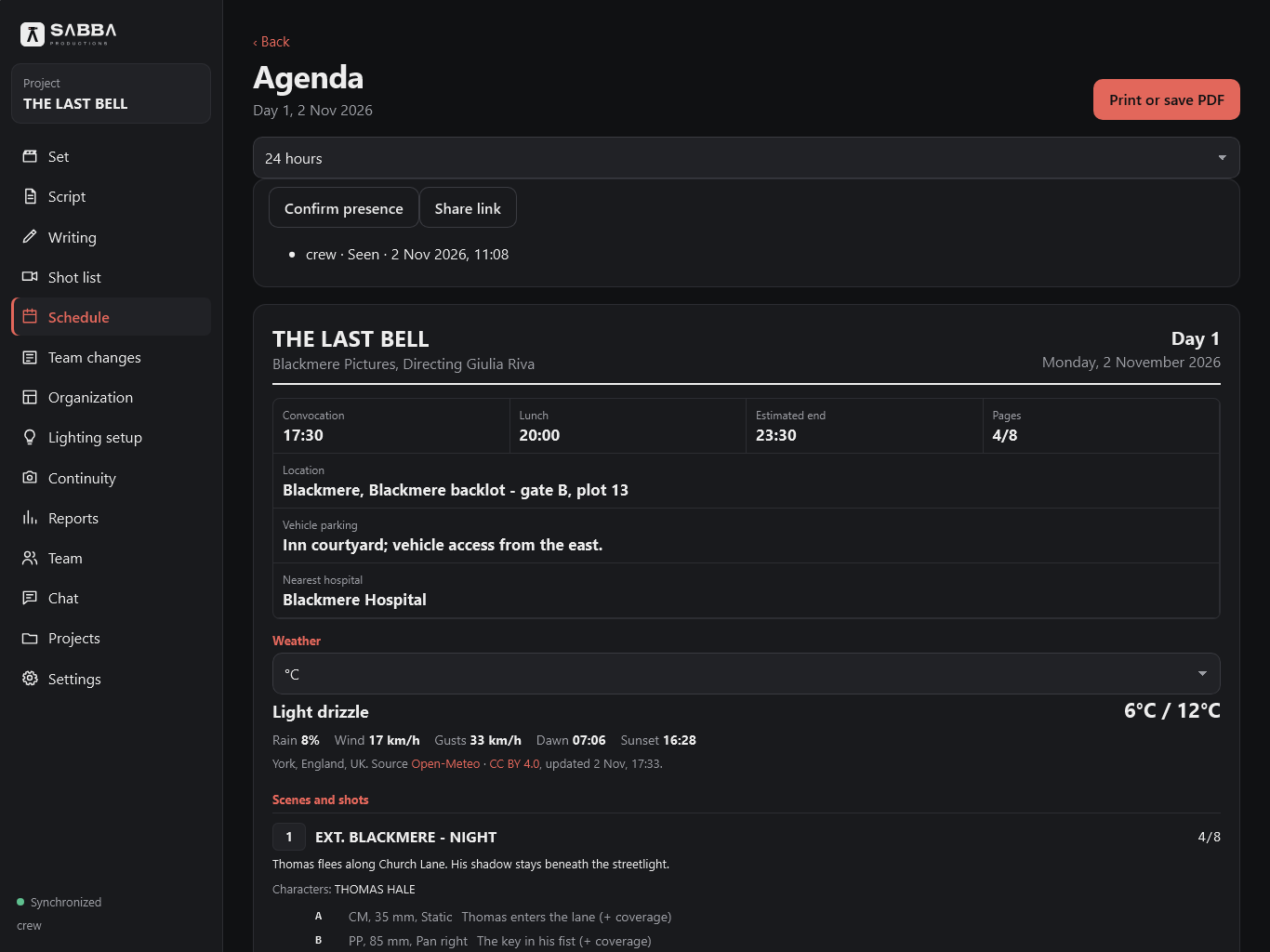
Worked example: day 1 of "The Last Bell"
| Item | Details |
|---|---|
| Day | Day 1 of 3, Monday 2 November 2026 |
| Times | Crew call 17:30 · meal break 20:00 · estimated wrap 23:30 |
| Weather | Light drizzle, 6-12 °C, wind 17 km/h · sunrise 07:06, sunset 16:28 |
| Scene | 1, EXT. BLACKMERE - NIGHT, 4/8. Thomas runs down the lane; his shadow stays under the streetlight |
| Characters | Thomas Hale |
| Location | Blackmere backlot, gate B, plot 13 |
| Parking | Inn courtyard, vehicle access from the east |
| Hospital | Blackmere Hospital |
| Wardrobe | Wet dark coat, grey scarf |
| Makeup | Wet dark hair |
| Props | Brass key, brown leather bag on the left shoulder |
The day has a single half-page scene. It's an exterior night scene in the rain, so it will take longer than its length suggests.
Before you send it
- The date and the day of the week match.
- The scenes are the ones in the latest version of the schedule.
- Every actor called appears in at least one scene, and every character in the scenes has an actor called.
- Each address opens the right spot on the map.
- The weather is updated on the evening you send it.
- The sheet carries a version number, so anyone who gets a correction knows which one to keep.
Common mistakes
- Mixing up crew call and first shot. If you just write "9:00", half the crew arrives at 9 and the other half expects to roll at 9.
- Times without a date. A correction sent at midnight leaves people unsure which day it means.
- Incomplete addresses. "The inn, back entrance" won't help someone arriving for the first time in a van.
- Several versions in circulation. A correction sent only in a group chat leaves half the crew with the old sheet.
- Safety notes at the bottom of the page, where they get lost between contacts and parking.
Making call sheets in 
In SABBA the call sheet comes from the shooting schedule: scenes, characters and department needs come from the breakdown, and the weather from the day's location. You share it with a link, the crew confirms attendance, and you print it or save it as a PDF.